The Triumph of Death
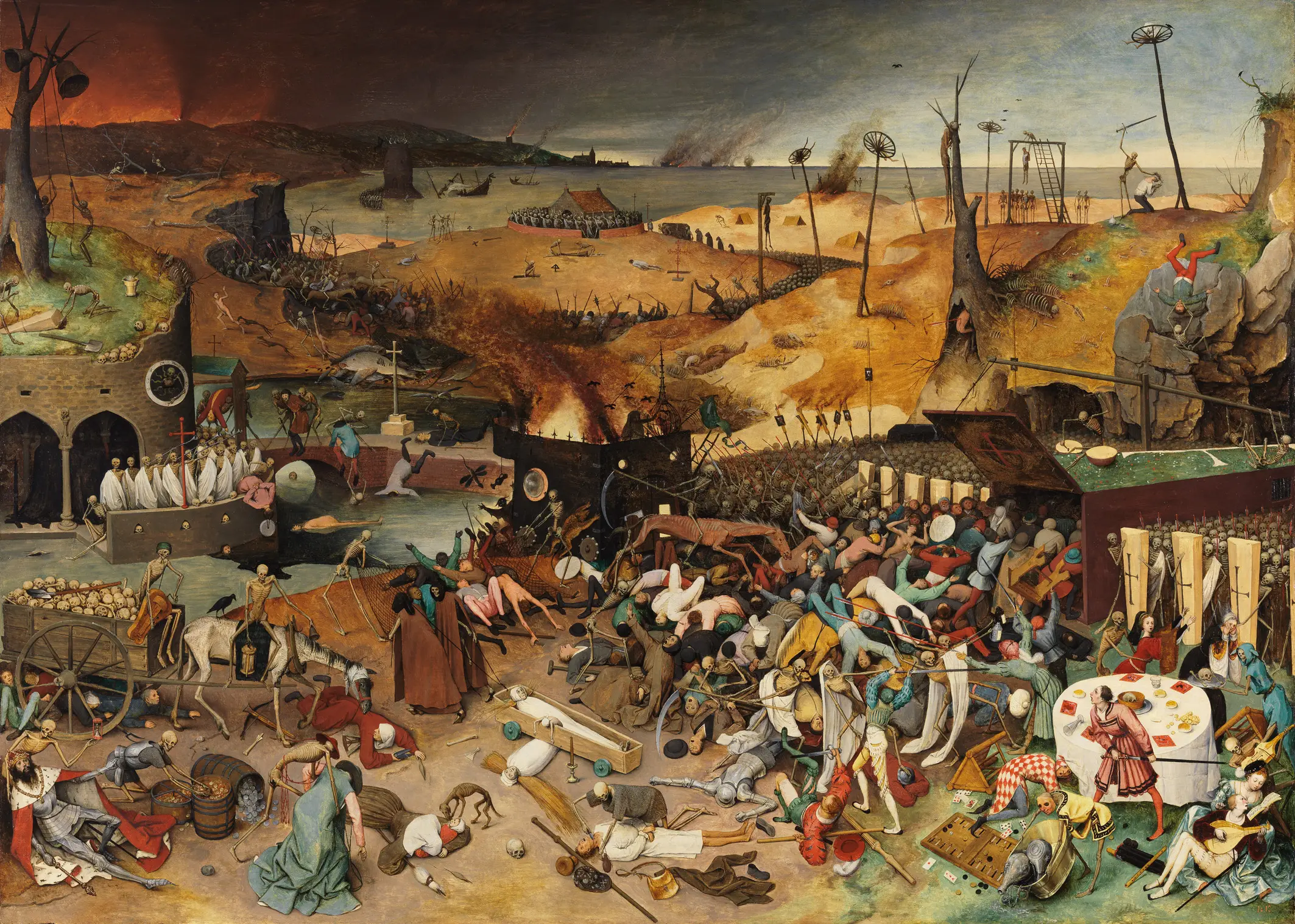
Bruegel's Triumph of Death hangs in room 055A of the Prado: an army of skeletons taking the whole world at once, painted around 1562. In all that crowd, two people still haven't noticed.
Where to find it
Room 055A, Villanueva building, ground floor.
Why it’s called a triumph
In ancient Rome, a triumph was the parade a general was given when he came home from a victory. Italian painters had long shown Death in one, as the winner, riding over the people he’d taken.
Northern Europe had its own picture of death, the Dance of Death: a skeleton comes for each person in turn, the pope, the emperor, the merchant, the peasant. Hans Holbein’s woodcuts of 1538 made it famous.
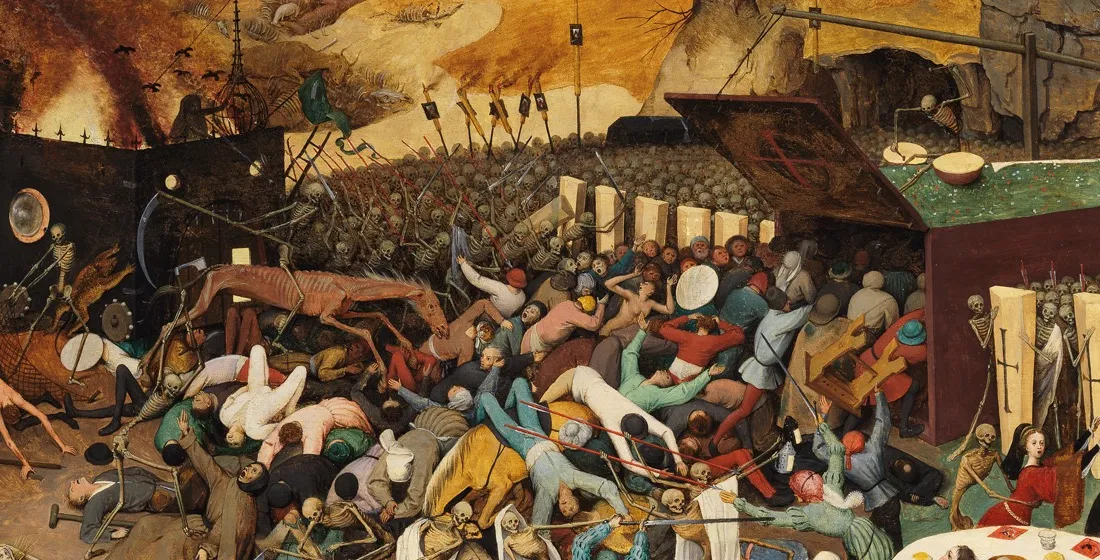
Bruegel put the two together and turned the parade into a war, in which everyone goes at once. Death rides through the middle on a reddish horse, swinging a scythe, while the skeletons behind him hold up coffin lids as shields and herd the living into a giant box with a red cross on its lid.
Details to look for
The panel is full of small scenes that are easy to miss at a glance. Here are seven.
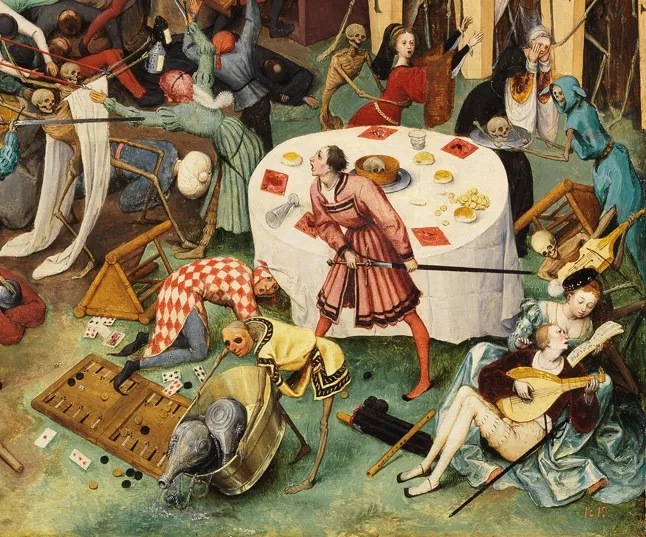
Two people who haven’t noticed. In the bottom right corner, a young man plays the lute to a woman holding a songbook. Neither has seen the skeleton behind them, playing along.
The last course. At the dinner beside them, a guest draws his sword, the jester crawls under the table, and a skeleton in a blue hood serves a skull on a plate.
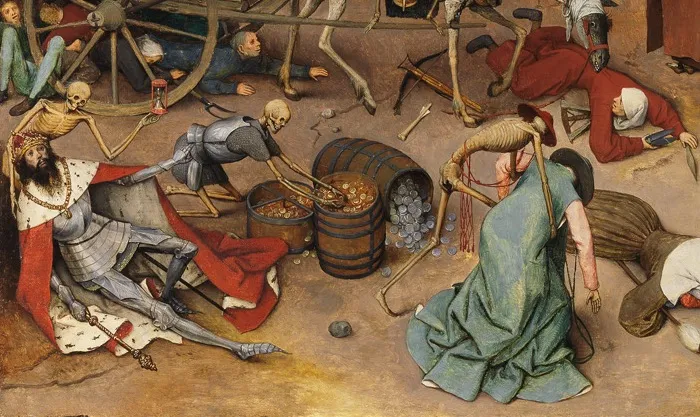
The king’s gold. In the bottom left corner, a king in armor and ermine lies dying. One skeleton holds up an hourglass to him, while another, in armor too, scoops coins out of his barrels.
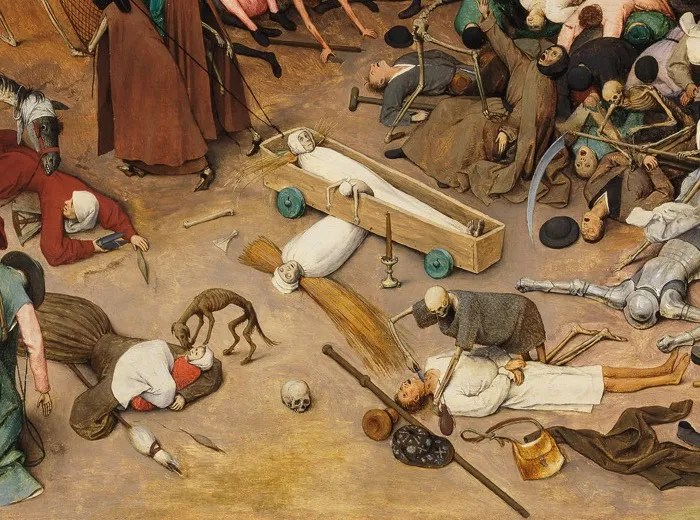
A dog and a baby. In the middle of the foreground, a starving dog bends over a baby lying on its dead mother. Next to them, a skeleton cuts a man’s throat.
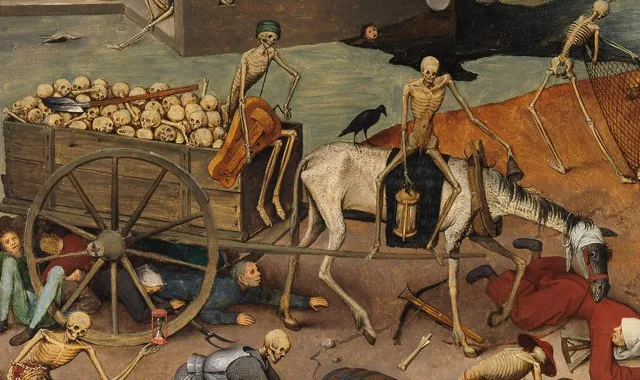
The cart of skulls. A skeleton on a thin white horse pulls a cart heaped with skulls, and its wheel rolls over the people in its way. Another skeleton rides on top, playing a hurdy-gurdy.
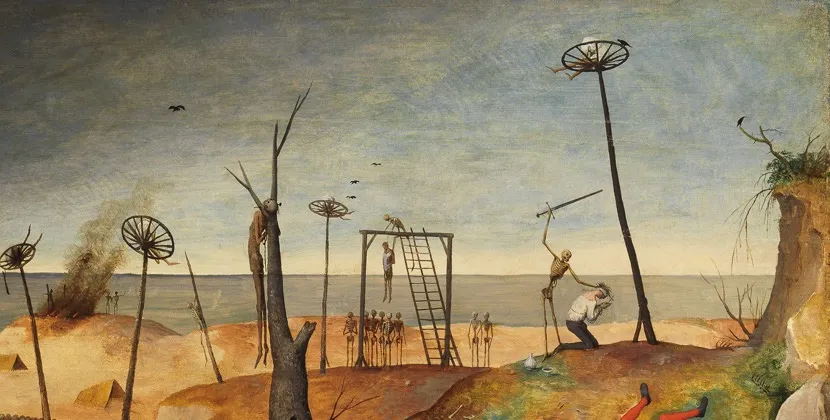
The executions. On a hill at the top right, a skeleton swings a sword over a kneeling man. Bodies hang from a gallows and a tree, and wheels on tall poles, where the bodies of executed criminals were left on display, stand against the sky.
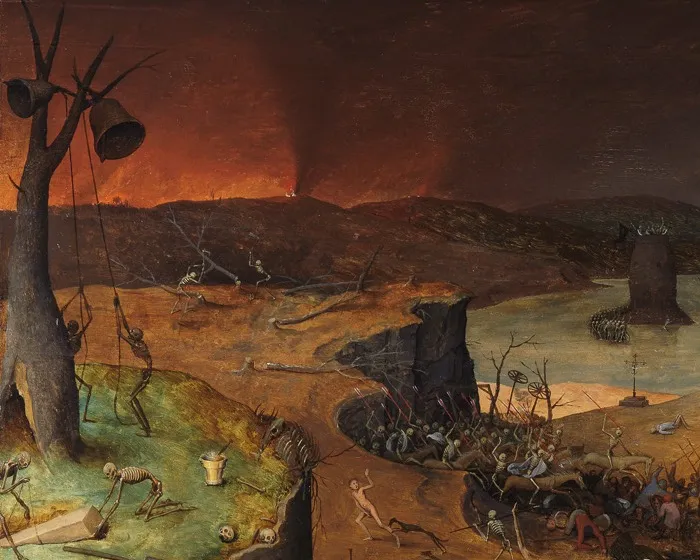
The end of the world. In the top left corner, two skeletons toll the bells hung in a dead tree. Towns burn on the horizon, ships sink, and dead fish lie on the shore.
What the restoration found
The Prado spent almost two years restoring the painting and put it back on view in 2018. Three things came out of that work.
It’s brighter. Layers of varnish from earlier restorations had dulled it. Removing them brought back its bright blues and reds.
There’s no signature. Bruegel signed and dated most of his paintings, but not this one. The restorer of the panel found no sign that the bottom board, where the name would go, had been cut down.
Two people he left out. Infrared photographs show two figures running across a field, drawn on the panel by Bruegel and never painted.
Who Bruegel was
You may know Pieter Bruegel the Elder from Hunters in the Snow or The Tower of Babel, both in Vienna. This painting looks different because of when he made it.
In 1562 and 1563 he painted three panels in the manner of Hieronymus Bosch: this one, The Fall of the Rebel Angels and Dulle Griet. Bosch had been dead for almost fifty years, and his kind of picture still sold.
He was sold as Bosch. In 1557 a print of Bruegel’s drawing Big Fish Eat Little Fish came out with Bosch’s name on it, not his. The Met thinks his publisher swapped the names because Bosch’s sold better. Bosch’s own Garden of Earthly Delights hangs next door, in room 056A.
He crashed weddings. His first biographer, Karel van Mander, wrote in 1604 that Bruegel dressed as a peasant to go to village fairs and weddings, bringing gifts like the other guests and claiming to be family of the bride or groom.
He had drawings burned. Van Mander also says that on his deathbed Bruegel had his wife burn drawings whose inscriptions were too sharp, out of remorse or for fear she’d suffer for them.
Who has borrowed it since
Since the 1970s it has served as the end of the world for a rock band, a novelist and a printmaker.
Black Sabbath, the English heavy metal band, put it on the front and back covers of their greatest hits album in 1977.
Don DeLillo opened Underworld, his 1997 novel of the Cold War, with it. At a baseball game in New York on October 3, 1951, pages of Life magazine rain down from the upper deck, and one that reaches J. Edgar Hoover carries The Triumph of Death. DeLillo found the idea in the next day’s New York Times, which put the game and a Soviet atomic test on the same front page.
Artemio Rodríguez, a Mexican printmaker, remade it for our century in 2007 as a woodcut in nine panels, 8 feet by 12. His skeletons come with factory smokestacks, a pickup truck, a barrel of oil, an ATM and a mushroom cloud. The Seattle Art Museum has a print.
The lovers in the corner
Sylvia Plath noticed the lovers too. In 1960 she published “Two Views of a Cadaver Room”, a poem in two halves: the first set in a dissecting room, the second in this painting, where “two people only are blind to the carrion army”.
Death has been one step behind them for more than 450 years, and the paint holds it there. Her poem ends on that thought:
Yet desolation, stalled in paint, spares the little country
Foolish, delicate, in the lower right hand corner.